TB-500
Certificate of Analysis
Each batch is tested by an independent third-party laboratory. Certificate of Analysis is available upon request.
What is TB-500?
What is TB-500?
TB-500 is a lab-synthesized peptide derived from a sequence of Thymosin Beta-4. Researchers frequently examine it in controlled studies for its potential involvement in wound models, angiogenic processes, and cellular structural pathways.
Frequently asked questions
Are your products tested?
Yes, all products are tested by third-party laboratories to ensure purity and potency.
What is the shipping time?
Orders ship same day from our facility and typically arrive within 5–10 business days.
Do you offer bulk pricing?
Please contact us for bulk order inquiries.
Made in China
Peptides are precision-synthesized and lyophilized at state-of-the-art laboratories.

TB-500 Overview
TB-500 is a synthetic peptide fragment derived from thymosin beta-4, a naturally occurring protein studied for its role in cellular repair and regeneration. Research has focused on its potential influence on tissue remodeling, angiogenesis, and cellular migration in preclinical and laboratory models. TB-500 is of particular interest in investigations involving connective tissue, muscle recovery, and wound repair pathways.
History
Thymosin beta-4 (TB4), the parent protein of TB-500, was first isolated in the 1960s during studies of thymus-derived peptides and their role in immune and regenerative biology. TB-500 was synthesized as a research analog to enable focused study on TB4’s tissue repair functions. Since its development, it has been investigated across models of angiogenesis, muscle regeneration, and cellular migration, with growing interest in its systemic regulatory potential.
TB-500 Structure
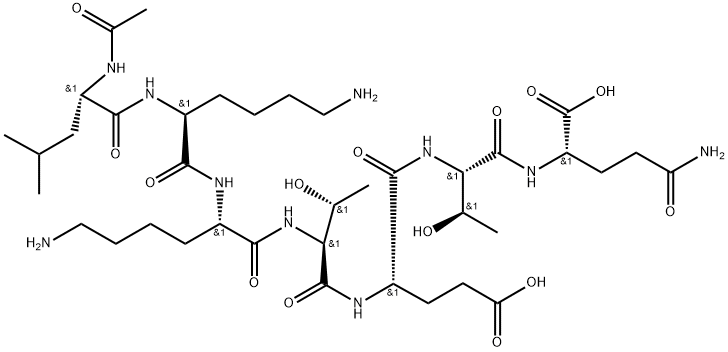
CAS #: 885340-08-9
Molecular Formula: C₂₁₂H₃₅₀N₅₆O₇₈S
Molecular Weight: 4963.5 g/mol
PubChem ID: 16132321
Research Findings
TB-500 has been studied in structural, vascular, dermatological, and systemic models, with research exploring its roles in collagen organization, extracellular matrix remodeling, angiogenesis, wound closure, and tissue recovery in preclinical settings.
Key Areas of Research:
• Structural: collagen, matrix, tendon/ligament
• Vascular: angiogenesis, nitric oxide, remodeling
• Dermatological: wound closure, inflammation, epithelium
• Systemic: protection, viability, recovery
Together, these findings suggest broad experimental utility for TB-500 across multiple biological pathways. By engaging structural and vascular processes and supporting epithelial and systemic responses, TB-500 provides a versatile platform for investigating tissue repair, recovery, and resilience in laboratory models.